
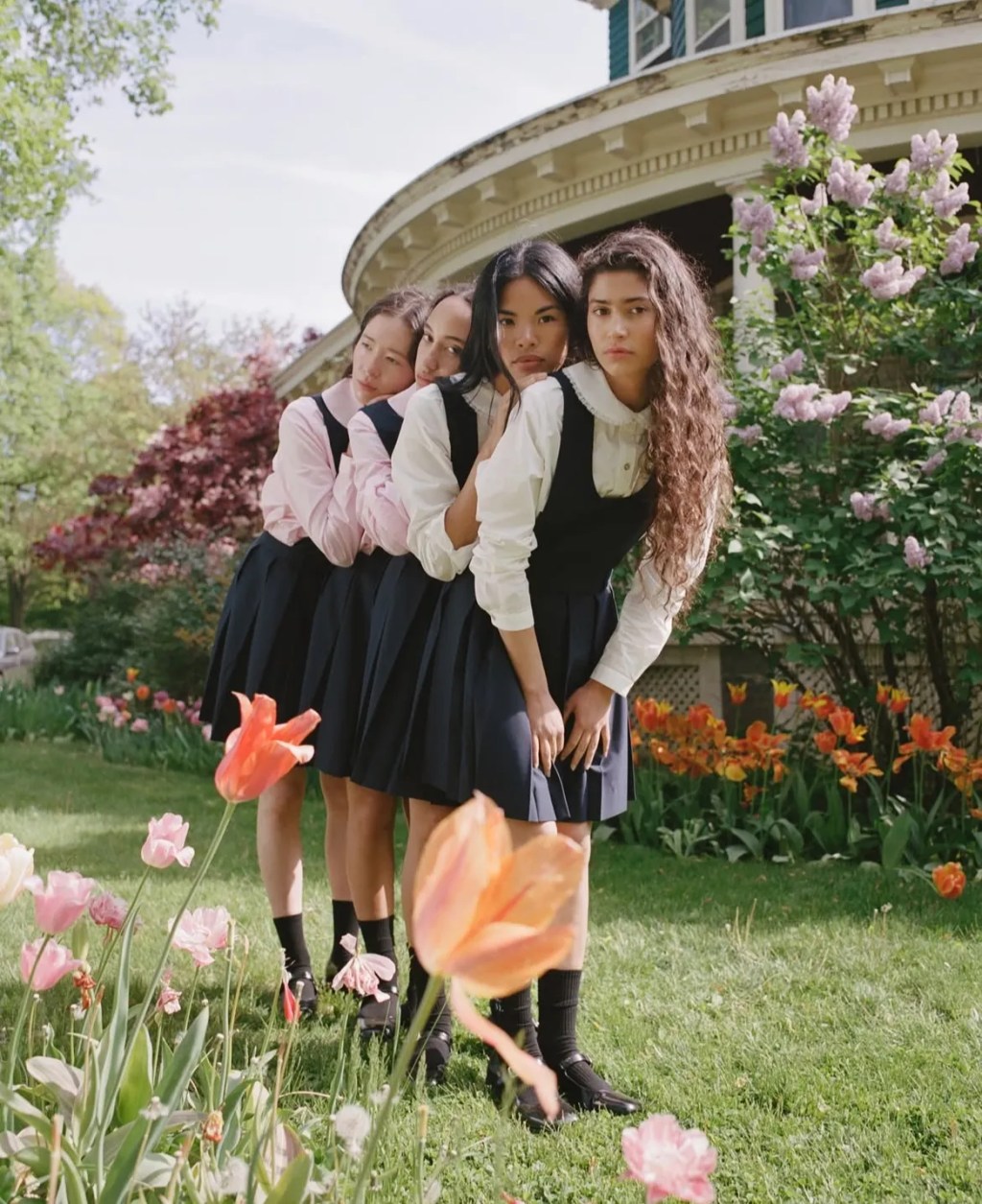
When I think of school uniforms, I think of polyester polo shirts and creased, knife-pleated skirts, black dress shoes with scuffed toes, or socks that are permanently grey from wear. And, if I really want to get visceral with my description, the lingering smell of sweat from PE class and Victoria’s Secret Love Spell.
In theory, the school uniform is supposed to symbolise equality and functionality. In practice, each uniform eventually becomes individual to the wearer, be it by a name scrawled on a fabric tag or the controversial choice of skirt length. The hyperreal uniform, by contrast, erases this messy, lived-in reality. It sanitises the worn, the dirty, the unfashionable, reducing the uniform to a set of recognisable elements: loafers, tartan and white blouses.
The school uniform has become a clean slate—something that can be warped, projected onto, and eagerly leveraged by capitalism. There are both positives and negatives to this. On one hand, there’s the perpetuation of fantastical and harmful tropes about girls in uniforms that overwrite the reality of lived experiences in school. On the other, the aesthetic’s revival opens space for reinvention. For the uniform to become something new, detached from its old connotations.
Outside the schoolyard, the uniform becomes a storytelling device in popular shows. Rory Gilmore’s (Alexis Bledel) innocence and intelligence is reflected in her modest, neatly pressed Chilton uniform. Meanwhile, the confident and fashionable Blair Waldorf (Leighton Meester) styles her uniform with loose ties, headbands, and thigh-high socks paired with heels.
In Japanese anime, sailor-style uniforms signify youth, purity, and cuteness. Sailor Moon would not be herself without her blue-and-white sailor suit. In Ouran High School Host Club, the crisp male-style blazers parody privilege and aspiration, while the female characters in pleated skirts become symbols of both conformity and comic subversion.
In South Korea, amusement parks like Lotte World have entire rental shops where visitors—many of them long past high school age—can hire a uniform for the day. The photoshoot is the point: giggling in blazers in a picturesque location, eating candyfloss, posing with cartoon mascots. These are all things we rarely did as actual students. School was, in reality, a full-time 9-to-3 burden, heavy with rules and growing pains.
At risk of sounding dramatic, wearing the school uniform, and in particular the school skirt—as a real girl in real school—is a historically, politically and socially charged experience. The earliest school uniforms for boys in the 16th and 17th centuries were based on military dress. When girls were finally included in mass education, their uniforms were designed not for equality but for modesty, domesticity, and clear visual distinction from boys. The skirt was chosen to reinforce “femininity,” whatever society deems it to be.
There’s something to be said about how successfully this idealised image of girlhood infiltrates the average woman’s wardrobe. Even I have a soft spot for tartan-patterned-anything and socks with black, shiny, Mary Janes. But perhaps there is a subtle message within all this—one that women have always been told: to never grow up. To never age.
So what’s the alternative? Non-gendered uniforms?
Maybe it’s not just about what we wear, but the freedom to decide—whatever that could look like. To view the uniform as something fluid, unbound by gender, age, or expectation. Designers like Sandy Liang are already doing that, turning the once-rigid silhouette into something playful, genuine and universal. That’s the best outcome of the uniform’s afterlife: a fantasy we can finally control.
 Third Space Magazine
Leave a comment