
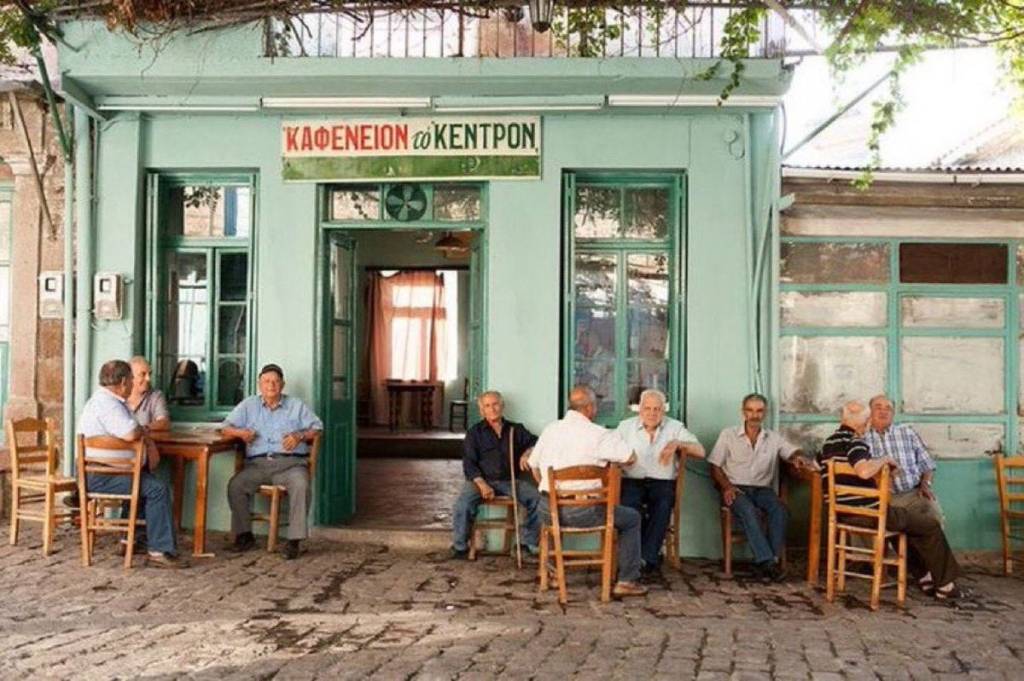
Perched beneath a sea of casuarinas outside the kafenio, the old boys are onto their second or third elliniko kafe. Dressed in their weekday-uniform of plaid shirts with the top buttons undone, they’ve ditched their Lowes windbreakers for the season. Adorned now in their weathered golf caps, they relay the town’s gossip in their village tongue.
Most of the time, they’re too engrossed in mindless conversation to notice anyone beyond their bubble. A circle of friends hanging out through time, a third space where they can meet without reservation.
A traditional kafenio can be found in every Greek town, village, island and city. It’s not your quintessential café by any means, but rather a hub for conversation, a place to gather, and a way of life. During the waves of Italian and Greek migration to Australia in the 1960s, cafes, takeaways, and taverns quickly popped up around thriving city hotspots, providing spaces to build community and recreate a sense of home thousands of kilometres from their roots.
For the diaspora, the kafenio acts as a parallel homeland, primarily serving older generations while preserving language, traditions, and cultural memory. It provides a space where stories from Greece are kept alive, creating continuity for those far from home.
While gatherings of older generations at a café aren’t unique to Greek culture—these customs of unstructured togetherness are evaporating at a rapid rate.
In big cities around Australia, the space between the personal and the public feels thinner. Beyond Europe’s piazzas and village squares, these casual corners of community—the spaces to linger without purpose—are becoming harder to find.
There’s always a murmuring of ‘where to next,’ or the night abruptly ending just as it begins. At times, it feels as though connection has become transactional, a checklist item, rather than intentional: something that lies at the very core of our human nature. After all, most of our best memories, or even our misfortunes, unfold in the spaces between life’s scheduled moments.
Greek kafenio culture, to me, stands as one of the last strong effigies of the 1960s migration—a living relic of what was once a hub for building community abroad. Within these spaces, motifs of my childhood form a blanket of comfort whenever I find myself passing through these suburbs, still untouched by gentrification, with a patriotism so palpable it could be served on a plate: evil eye shrines, iconography with scripture of orthodoxy, sepia-toned portraits of Greek football teams.
In an age where such microcosms are vanishing, the kafenio remains both a sanctuary and a testament to a diaspora’s enduring spirit.
And yet, for all this utopic vision of community, the practice is dissolving as younger generations rarely take these seats. Our “third spaces” are mostly wellness centres and online platforms. The suburban kafenio, once the heart of Greek life, now survives mostly with its creators: Australia’s first Mediterranean migrants.
As these spaces dwindle, I find myself reflecting on what it means to lose cultural memory to assimilation. I suppose the fading of these spaces—especially those tied to my cultural heritage—leaves me longing for a side of my Greek-Australian identity that feels distant, almost dreamlike, and perhaps like it never fully existed. I find myself escaping into memories of golden afternoons of big backyard BBQs, cards at my grandfather’s roundtable and wine shared with neighbours over the backyard fence. These intimate, unstructured gatherings were the heart and soul of the community and without them, I feel as though I’m clawing onto the last crumbs of my identity by yearning for the nostalgias of my childhood. (A yearning that, I fear, has hardened into a defining trait of my personality lol.)
I often take pride in my rich cultural heritage, in how my family remains deeply rooted in Greek traditions—something that feels completely natural to me, but which others might see as unfamiliar or unique. Of course, I am first and foremost an Australian woman. But my connections to the motherland often pull my allegiances into two.
It’s bittersweet to think that one day this generation will fade, and with it, perhaps the lived nuances of this dual connection to Greece and home. Yet the memories endure, and perhaps it is now up to me to pass them on.

 Third Space Magazine
Leave a comment