
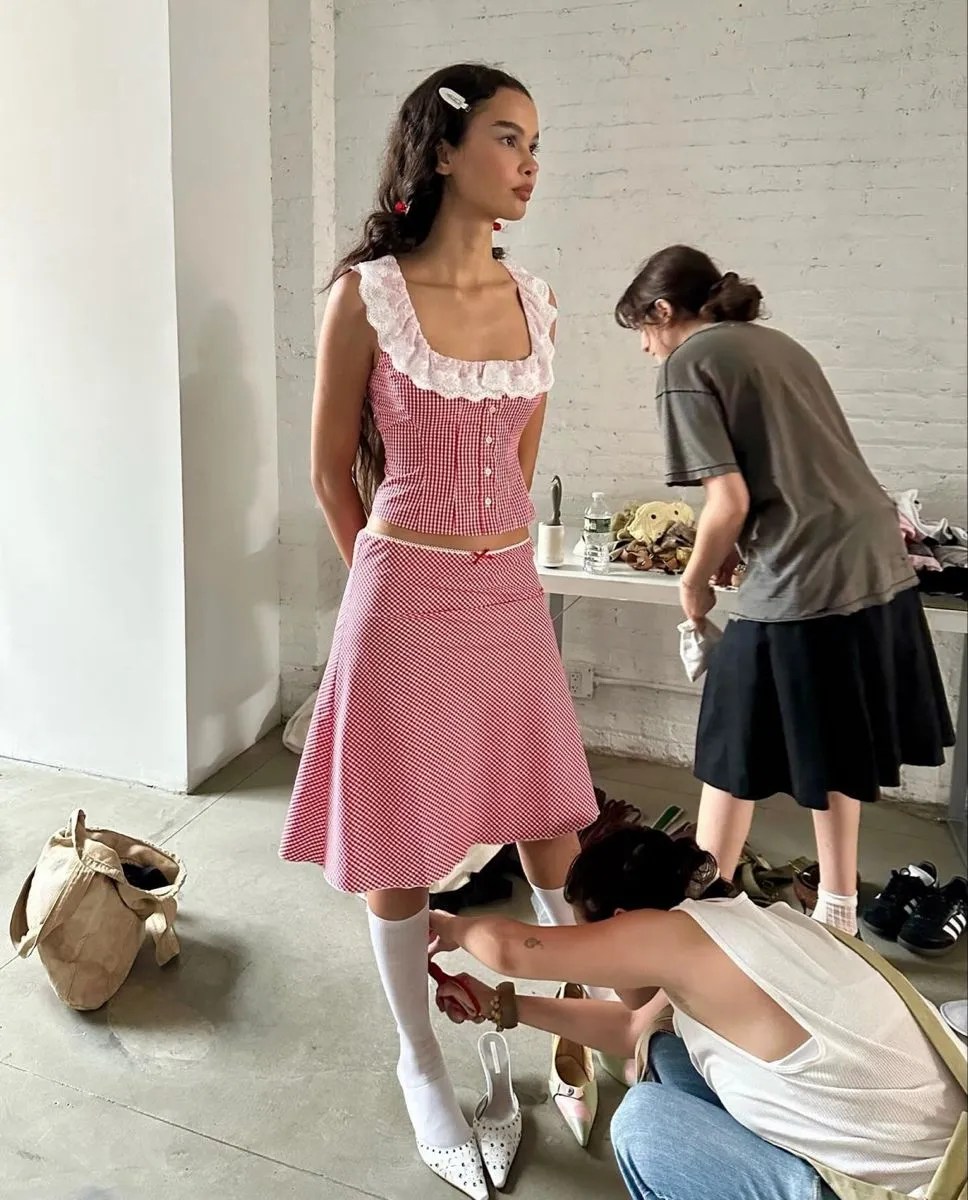
My first well-loved gingham piece was a pair of pants I bought from Japan when I was nineteen–just when I was coming into my true sense of style. They were interesting enough to be bold, but understated enough to be everyday-chic. I can safely say they were on rotation in my wardrobe for a generous amount of years, before they were surrendered to the Depop overlords.
As I write this, I can feel the gingham itch again. It’s almost like every time summer rolls around in the Northern Hemisphere, the call of the pattern comes back to me. And I’m not alone–searches for gingham skirts have spiked by 350% this year, proving that the pattern’s influence remains strong. The check is everywhere again: in flirty two-pieces (see Sabrina Carpenter’s ‘Manchild’ release fit), smocked mini-dresses, and retro revival one-piece swimsuits.
Florals fade for me. Stripes tire. Leopard is fun for a second. Gingham, however, just endures.
The reason for that might lie in its history. Even though it’s now closely associated with picnic blankets, prairie dresses, or even a Muji bedspread, gingham didn’t start there. Its origins trace back to Southeast Asia—India and Indonesia—where early versions of the fabric were woven in vibrant colours and rhythmic patterns before they were colonialised adapted by European traders.
By the mid‑18th century, gingham was mass-produced, becoming a staple for everything from school uniforms to tablecloths, thanks to its durability, breathability, and low maintenance. And honestly, that utility is part of the charm. It doesn’t wrinkle easily, it hides stains, and it suits just about everyone.
As trends evolve, gingham seems to do the same. In the 1950s, pastel gingham reigned in a-line dresses and full skirts, undoubtedly boosted by Judy Garland’s baby-blue pinafore in The Wizard of Oz. In the ’90s, black gingham took a darker turn and slipped easily into the grunge scene. Today, it lives happily within our endless appetite for soft nostalgia and cottagecore escapism.
It’s also become a kind of fashion shapeshifter. Miuccia Prada, Simone Rocha, and Jacquemus have all played with gingham in recent collections—using it to both poke fun at and pay homage to traditional femininity.
So yes, gingham is having another moment. But then again, it never really left.
 Third Space Magazine
Leave a comment