
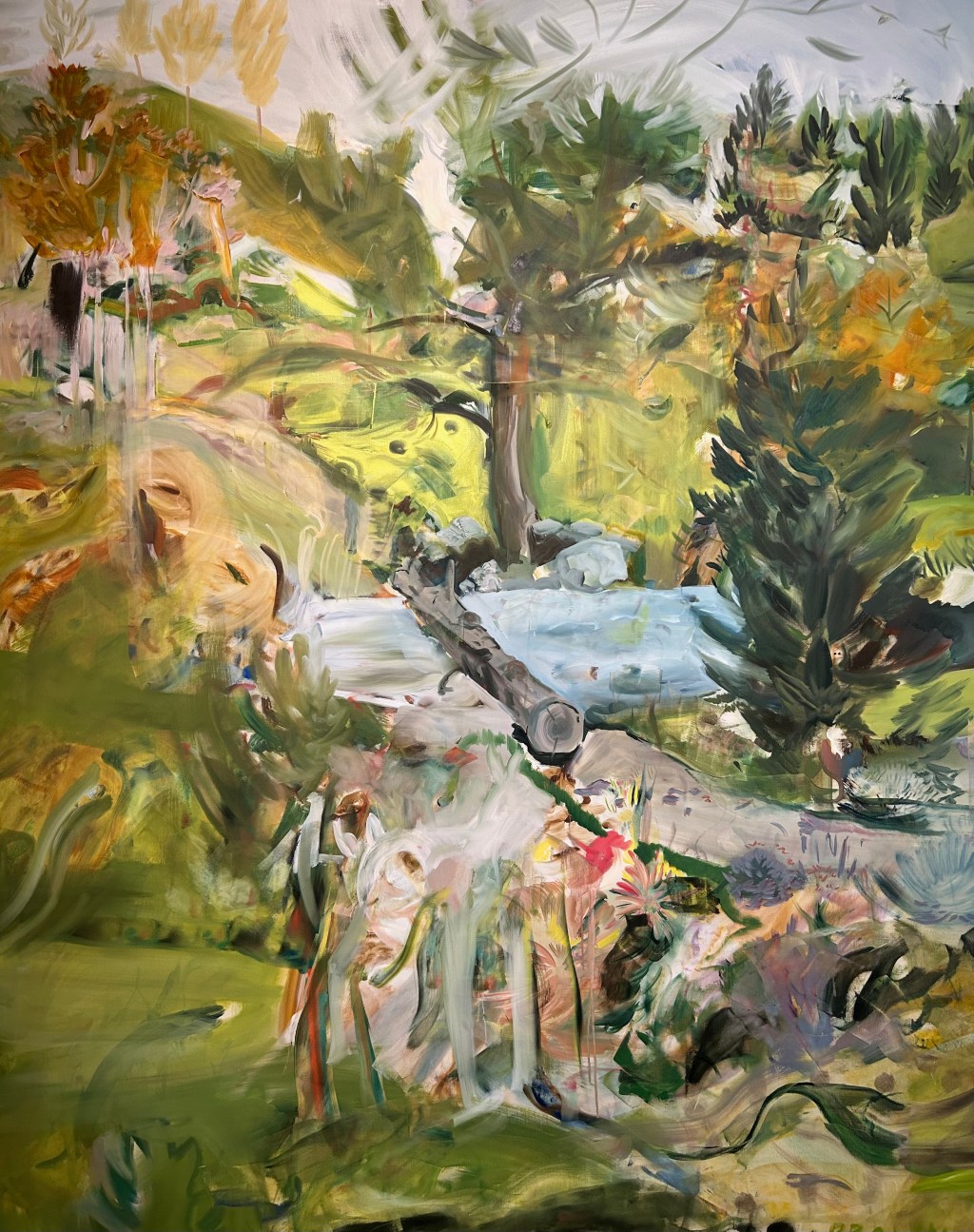
Cecily Brown once said: “One of the main things I want my work to do is to reveal itself slowly, continuously, and for you to never really feel like you’ve finished looking at something (Louisiana Channel).“’Picture Making’ at the Serpentine South Gallery feels like a direct articulation of this impulse.
The show gathers works from 2001 to the present, forming a cohesive snapshot of Brown’s evolving practice. Across varyingly sized supports, familiar motifs recur: entwined couples, playful woodland scenes, and fragments of riverbeds dissolving into flurries of brushwork. These images oscillate between recognition and abstraction, never fully resolving, urging the viewer to study them closely, and then some.
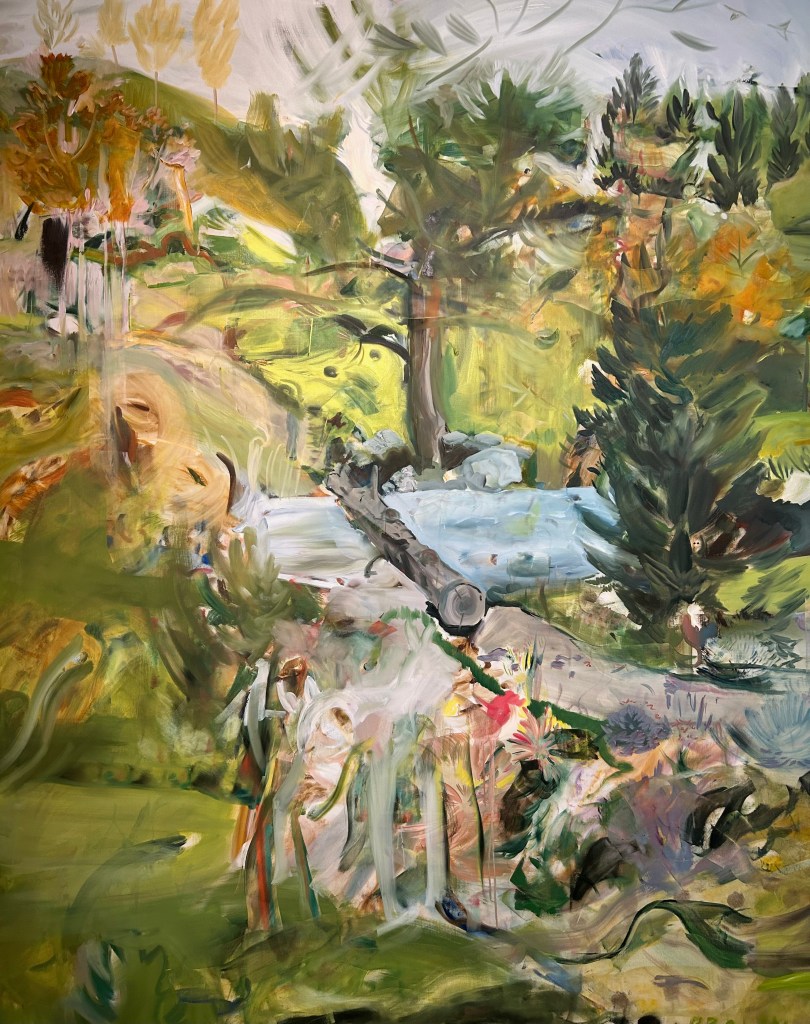
Trees, a lake, a log cabin, a waterfall, a deer and a sunset (2024)features a composition that stretches across the canvas so that the eye is forced into motion. It moves from corner to corner—registering the blue of the water, the log across the lake, the yellowing trees in the top left, the darker vertical of a tree at the middle-right. There is a flurry of figures and green; there is movement without hierarchy. You don’t quite know where to settle, but you carry the uncanny sense that you have seen this all before.
Continuity—of familiar scenes, of brushstrokes—is the exhibition’s most persistent anchor. Brown’s intuitive approach, allowing paint to lead rather than describe, results in compositions that feel both immediate and elusive. In A Round Robin (2023–24) the fleeting glance of a dark landscape surfaces and recedes almost simultaneously. Gestures, forms, and colours seem to footnote other pictures in the show. The works do not present a stable image so much as an ongoing act of realisation.
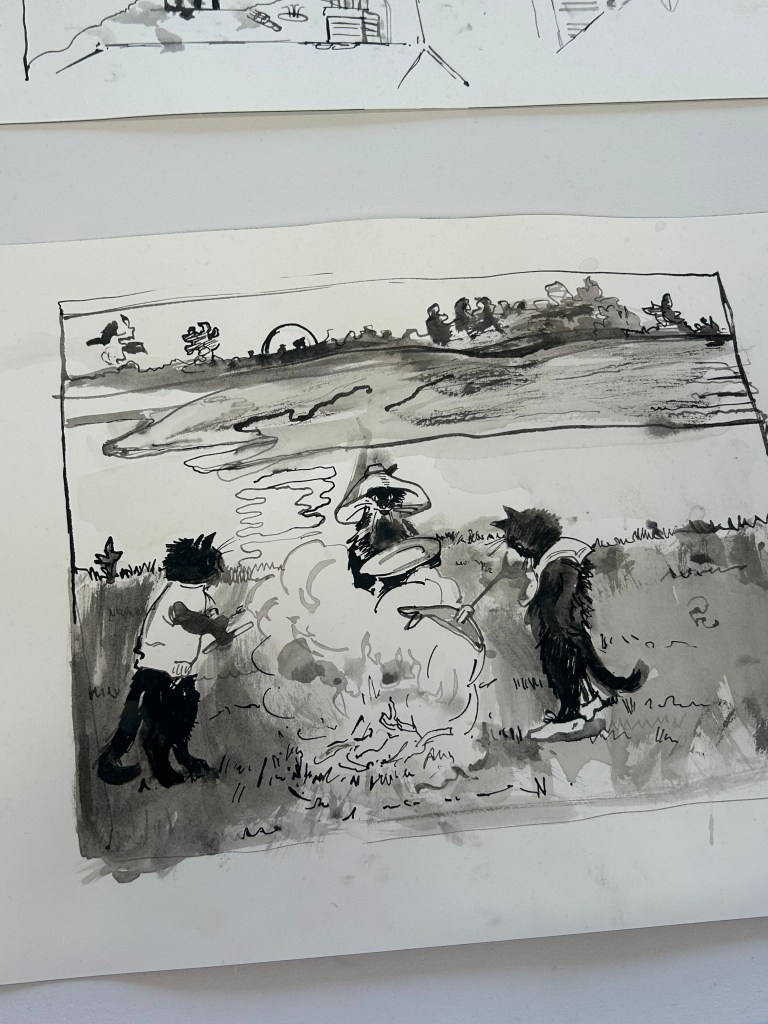
The exhibition is well-suited to its setting. Nestled within Kensington Gardens, the gallery situates Brown’s paintings within a landscape that feels both intimate and historically weighted. Her references—to canonical Western painting as well as the visual language of children’s book illustration—extend into her drawings, where anthropomorphic cats tinker away like blue-collar workers within calm, pastoral scenes. These moments introduce an underlying tension between innocence and unease. The decision to paint sections of the gallery walls a deep burgundy, rather than the expected white, intensifies this atmosphere, lending the works a darker, more enclosed resonance.
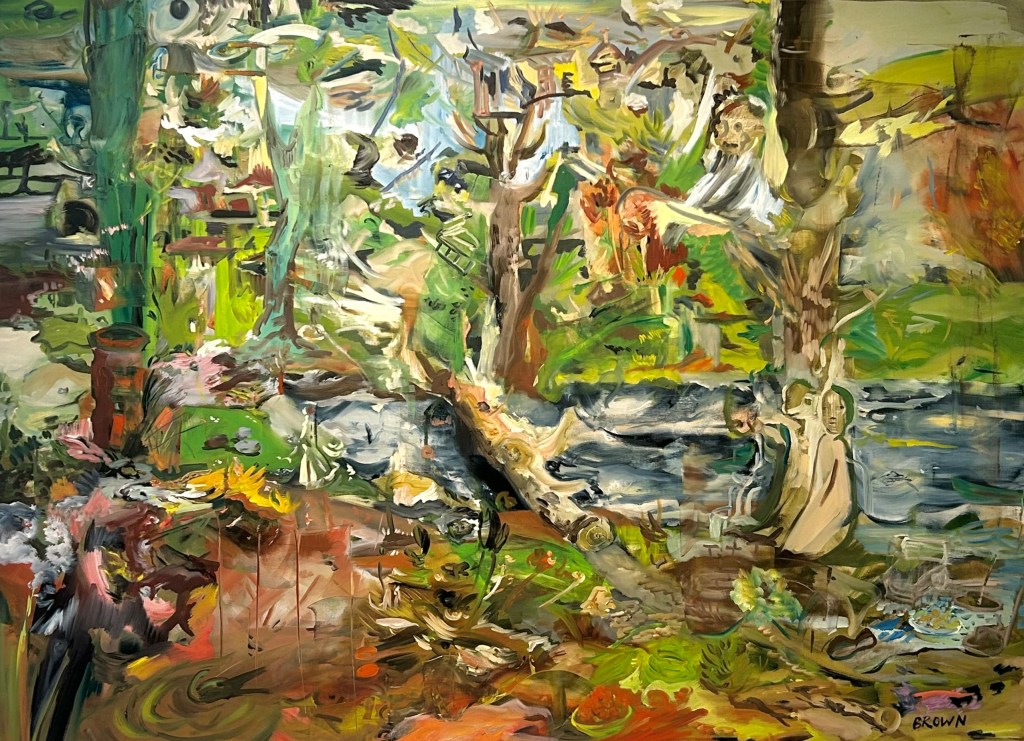
Viewed in rapid succession, the paintings trace a movement between childhood and adulthood, one that becomes more pronounced as her earlier, more overtly figurative works give way to the increasingly complex surfaces of her later paintings. Couple (2003–04) offers a clearer example of figuration embedded within density. The entwined bodies remain legible: the brow, ear, and hairline of the male figure cut sharply through the surrounding jungle of brushwork. By contrast, Nature Walk with Nymphs (2024) opens into brightness and less assuredness. Fleshy strokes drift around a blue pond, their faces small and half-lost, while the recurring log across the river tenuously grounds the scene in reality.
Brown’s strong engagement with the English landscape brushes against the darker undercurrents of Western nursery rhymes and cautionary tales. I happened, just after, to pass the nearby Peter Pan statue—a monument to a story so deeply embedded within London’s cultural oeuvre. It is often framed as innocent despite it being so grounded in colonial fantasy, possession, and existentialism—elements that echo through British history more broadly. In that moment, Brown’s paintings became reflections of the porous, and feeble boundaries between the body and its environment, each shaping and unsettling the other in equal measure.
‘Picture Making’ is on at Serpentine Galleries from 27 March to 6 September 2026. Entry is free.
 Third Space Magazine
Leave a comment