
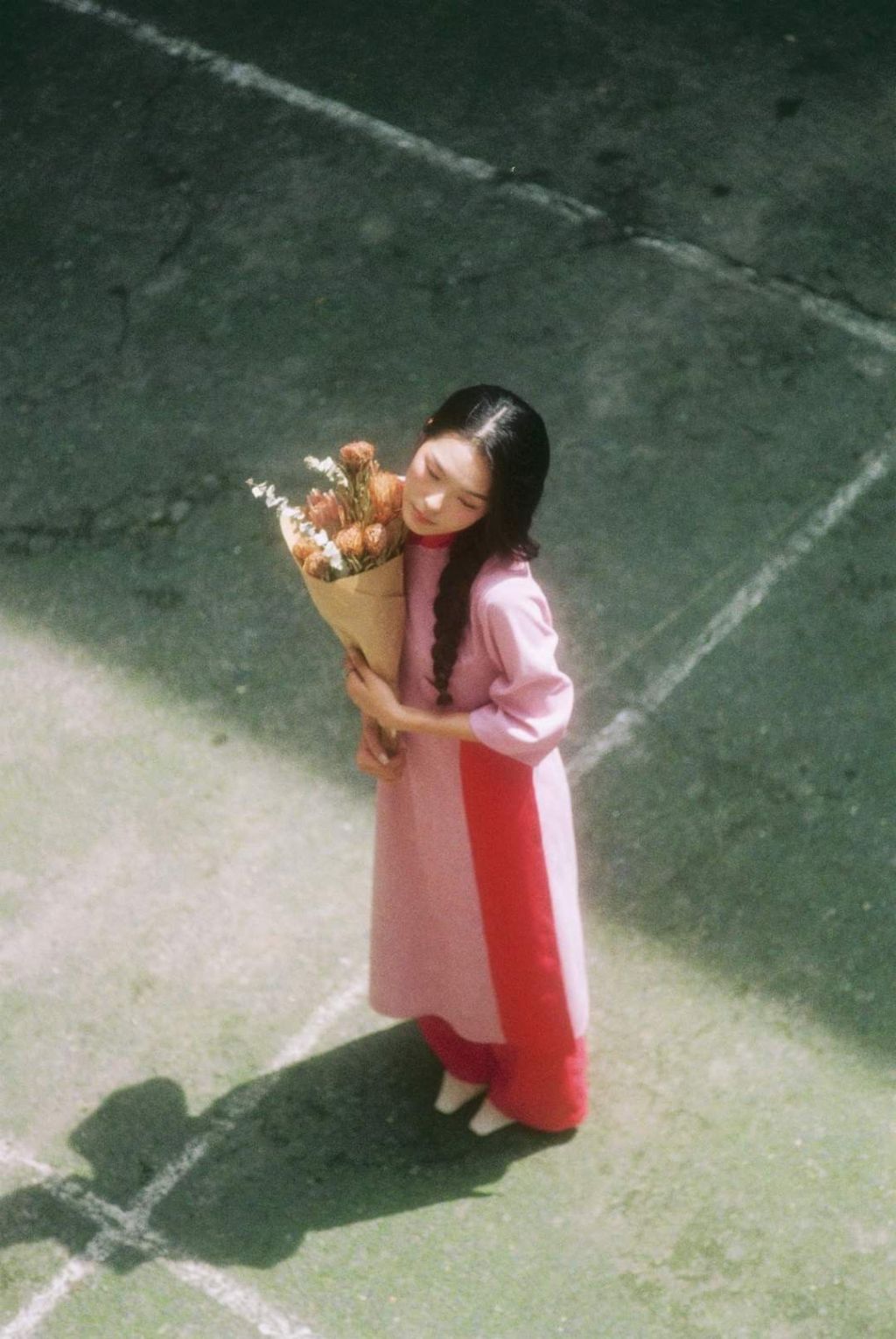
Layering garments has become a tell-tale sign of someone who takes their style seriously (albeit, playfully). I commend the fashion icons strutting down the street with a billowy skirt over Adidas track pants, a stream of fabric gracefully trailing behind them. Prior to its resurgence in every cool girl’s wardrobe, layering had become a lost art form in modern Western fashion. As a child of Vietnamese diaspora, I can’t help but link the recent trend to the iconic Vietnamese garment, ào dài. A long tunic dress over wide leg trousers typically custom designed by a tailor to fit one’s form, this two-piece garb personifies Vietnamese cultural identity through historical tensions, an embracement of modernity and the power of the feminine.
Age-old narratives link the garment to the Dong Son people, a Bronze Age civilisation, who dwelled along the Red River Delta more than 2000 years ago. They were sophisticated seafarers with a knack for artisanal metal work, archeologically known for their intricately designed and expertly crafted bronze drums1. Etched onto the face of the drums are patterns that capture the forgotten past ,uncovering a possible precursor garment to ào dài. Visible in the design of the drum face are women ordained with five layers of fabric, floor length skirts, a fitted bodice, a two flap fabric front, and bronze trinkets2.
The Trung sisters (Hai Ba Trung), Vietnam’s first female generals, are often depicted as the first two women to wear ào dài; legend says that “when the Trung sisters went to battle, they rode elephants, wore two-panelled golden armour, covered with a golden parasol, and were splendidly decorated…”3. This two-panelled golden armour is said to be an early version of ào dài, and to honour these sisters, other women at the time distinguished themselves by fashioning a four-panel garb instead. Leading an army of mostly women into battle, they triumphantly led the rebellion against the Han Chinese dynasty who colonised parts of Northern Vietnam. They are worshipped as national heroes, doused in Vietnamese resilience and resistance.
The origins of ào dài are debated through murky historical retellings, as iterations and alterations modified the garment across centuries. Geopolitical divisions of Vietnam had the attire of the Northern Kingdom, influenced by the Han Chinese–boxy robes with wide gaping sleeves, and a cross-collar that overlaps to the right atop a long skirt3,4. As a distinct marker of time, the year 1744 pinpoints the imagining of the garment as we know it. The lords of the Southern Kingdom had their courtiers dressed in loosely fit trousers under flowy robes instead, influenced by both Han Chinese and Champa culture–symbolic demarcation in difference to the North through fashion, birthing the inception of contemporary (-ish) ào dài 3,4.
By the 1930’s, cultural identity was interlaced with French colonial influences. Provoking controversy, LeMur (Nguyễn Cát Tường), a fashion designer from Hanoi, introduced Western influences. Accentuating a woman’s figure, the tunic was constructed to flatter and form, with critics claiming LeMur’s adaptation was too inappropriate for traditional Vietnamese wear4. As the United States gained political power in the 1950’s, Trần Lệ Xuân, the wife of the country’s chief advisor, embraced Western fashion, parading ào dài with a boat neck and shorter sleeves to reveal more skin, with the addition of gloves (very Audrey Hepburn-esque). This modern expression of femininity gained as much praise as it did backlash–Trần’s version was banned by the government because it supposedly promoted capitalist ideals3. Yet the power of her influence on the garment prevailed, as tailors and other women followed her lead.
I believe there is room for both forms of ào dài.Traditional versions connect us to our ancestral lineages, proud histories and sense of belonging. Modern adaptations give space for innovation and creativity–why can’t ào dài be high fashion or a conversation starter? In Vietnam today, subversive fashion brands in Ho Chi Minh City are reimagining the ào dài with figure hugging mesh and screen-printed graphic designs. From sleeveless to halter necks, to traditional silk compositions and alterations with nylon or linen, the evolution of ào dài has and always will be a sign of the times. This may be where tradition is honoured but not forgotten, and modernity and global influences are invited to take part in the conversation of what constitutes ào dài.
Personal style is becoming more and more experimental. People aren’t afraid to throw together contrasting textures, colours, patterns and pieces. Even so, áo dài showcases the timeless beauty, simplicity and functionality of layering.
Footnotes
1Bankston III, Carl L. 2022. ‘Dong Son Culture | Research Starters | EBSCO Research’, EBSCO <https://www.ebsco.com/research-starters/anthropology/dong-son-culture>
2Vietnam Investment Review. 2016. ‘Vietnamese Ao Dai: From Dong Son Bronze Drum to Int’l Beauty Contests’, Vietnam Investment Review – VIR (https://vir.com.vn/) <https://vir.com.vn/vietnamese-ao-dai-from-dong-son-bronze-drum-to-intl-beauty-contests-40377.html>
3Hity. 2023. ‘Ao Dai – Past and Present’, Hity <https://hityfashion.com/en/blogs/share/ao-dai-cua-chung-ta?srsltid=AfmBOorl0X5CliQBGibTSA6K5OoFmd6-LHwaqtI96dXOpoWa_yf6eNg-> [accessed 16 May 2026]
4Jake Hornberger. 2017. ‘The 2000 Year History of the Vietnamese Ao Dai’, Vietcetera <https://vietcetera.com/en/the-2000-year-history-of-the-vietnamese-ao-dai>
 Third Space Magazine
Leave a comment